

A cardiologist can investigate your coronary disease and recommend bypass, but a cardiovascular surgeon performs beating-heart bypass surgery. You will be able to identify the right specialist, confirm whether OPCAB is currently offered, request the correct appointment, and prepare the records needed for a safe decision.
Key takeaways
- A cardiothoracic surgeon, not a cardiologist, performs OPCAB.
- Compare OPCAB, on-pump CABG, MICS CABG and stenting with your heart team.
- Call the hospital to confirm current OPCAB availability and surgeon experience.
- Bring angiography images, reports, medicines and medical history to your appointment.
Which specialist evaluates and performs beating-heart bypass surgery?
The cardiovascular or cardiothoracic surgeon performs beating-heart bypass surgery, usually called off-pump coronary artery bypass (OPCAB). A cardiologist in Nagpur can assess chest pain, review angiography and recommend bypass, but does not perform the operation.
If you search “beating heart bypass surgery for available cardiologist in Nagpur,” separate the referring specialist from the operating surgeon:
| Specialist | Main role | What you should ask |
|---|---|---|
| Cardiologist | Diagnoses heart disease, reviews tests and recommends medicines, stenting or bypass | Can you refer me for a coronary surgery opinion? |
| Interventional cardiologist | Performs coronary angiography and catheter procedures such as angioplasty and stenting | Is PCI suitable, or should a surgeon assess CABG? |
| Cardiovascular or cardiothoracic surgeon | Assesses grafting, selects the surgical approach and performs OPCAB or on-pump CABG | Do you personally perform OPCAB, and how often? |
A bypass recommendation does not prove that OPCAB is suitable. The surgeon must decide whether every important blocked vessel can be grafted safely, whether heart function and other illnesses increase risk, and whether on-pump CABG offers more complete revascularisation.
Difficult coronary targets can require conversion to a heart-lung-machine-supported operation if exposure or blood pressure becomes unsafe.
For an opinion, request a cardiac surgery or coronary revascularisation consultation, not only a general symptom visit. Confirm availability at the operating hospital: ask about the named surgeon’s current OPCAB practice, cardiac intensive care, anaesthesia cover, blood-bank access and emergency conversion support. An online cardiologist profile alone cannot confirm an available operation.
How do doctors choose between OPCAB, on-pump CABG, MICS CABG and stenting?
The choice starts with coronary anatomy, not the label “beating heart.” The team reviews the number and location of blocked vessels, target-vessel access, heart function, arterial calcification, previous chest surgery, diabetes, kidney disease and other coexisting conditions. The surgeon’s experience with each technique also affects the recommendation.
| Option | What it means | When it applies | Main limitation |
|---|---|---|---|
| OPCAB | Bypass grafts are made while the heart beats, without a heart-lung machine | Suitable targets can be exposed and stabilised safely | Deep or difficult vessels can increase incomplete-grafting risk |
| On-pump CABG | The heart-lung machine supports circulation during conventional bypass | Multiple, deep or technically difficult targets need reliable exposure | Uses cardiopulmonary bypass and a stopped-heart technique |
| MICS CABG | CABG through smaller chest incisions or a limited access route | A suitable target pattern and surgical approach permit less invasive access | It describes the incision, not whether surgery is beating-heart or on-pump |
| Angioplasty with stenting | A catheter opens the blockage and places a stent | Fewer suitable lesions, accessible anatomy and appropriate clinical risk | It may not provide complete or durable treatment for complex multivessel disease |
A cardiologist may recommend angioplasty with stenting when anatomy suits it; CABG becomes more compelling when several vessels, the left main artery or complex calcified disease require durable grafting. For OPCAB in Nagpur, ask how the team protects against incomplete revascularisation.
If exposure is poor or blood pressure and heart function become unstable, conversion to on-pump CABG using a heart-lung machine may be necessary. Availability of beating-heart bypass surgery in Nagpur does not guarantee that OPCAB is safe for every anatomy.
How can you confirm that OPCAB is currently available in Nagpur?
Confirm OPCAB in Nagpur with the hospital where the operation would occur, not an online listing or a cardiologist’s profile. A profile can show that a doctor discusses coronary disease; it does not prove that the named cardiac surgeon currently performs beating-heart bypass surgery in Nagpur or that the operating team has an open schedule.
Ask the hospital these questions before travelling:
- Does the named cardiac surgeon personally perform OPCAB, or does another surgeon operate?
- How frequently does this team perform OPCAB, and when was its most recent case?
- Is conventional on-pump CABG available at the same hospital if exposure or blood-pressure stability makes conversion necessary?
- Are cardiac intensive care, cardiac anaesthesia and blood-bank access available on site?
- Can the hospital provide emergency re-exploration and rapid conversion to heart-lung-machine support without transferring you?
Contact Dr K G Deshpande Memorial Centre directly to confirm the current cardiac surgeon, consultation or surgery scheduling process, and these facilities. Treat that conversation as verification only: a listed OPCAB service does not prove that a surgeon is available on your preferred date.
Ask for the answer in writing, or record the name and role of the person who confirms it. If staff cannot identify the operating surgeon or explain the backup pathway, seek another centre before committing to travel.
Related product
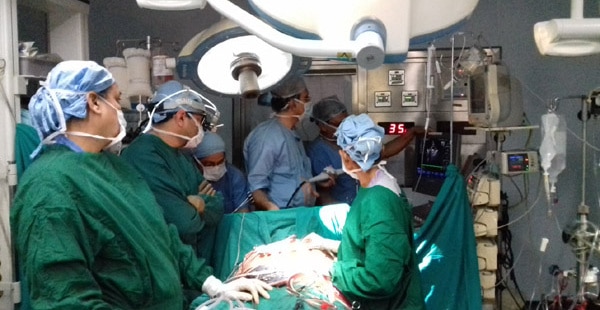 | Beating Heart Bypass Surgery / Completion Angiography MICS CABG / OPCAB / Small Incision Cardiac Surgery Valve Surgery Vascular Surgery Thoracic... View product → |
How do you book the right bypass surgery appointment in Nagpur?
Contact the hospital’s cardiac-surgery desk or a cardiologist in Nagpur and request a bypass surgery appointment in Nagpur. Ask specifically for a cardiac surgery or coronary revascularisation consultation, not only a general symptom visit. A referral is not always required; confirm this when booking. The cardiac team may arrange review by the operating surgeon.
Bring or send these records:
- Coronary angiography images, preferably on the original CD or secure digital link, plus the written report
- ECG and echocardiogram report
- Complete blood count, blood group, kidney-function results, and glucose or HbA1c
- Current medication list, doses, and allergy list
- Diabetes and kidney-disease records
- Previous operation notes
- Stent details, including the implantation report and stent location
- Insurance card, policy details, and pre-authorisation documents
| Appointment type | What it provides | What to request |
|---|---|---|
| General symptom visit | Initial assessment of chest pain or breathlessness | Use when diagnosis is still unclear |
| Cardiology consultation | Review of tests and referral planning | Ask whether surgical assessment is needed |
| Cardiac surgery or coronary revascularisation consultation | Assessment for CABG, including OPCAB, versus PCI or medical treatment | Request this when angiography already shows significant disease |
Ask when the hospital will confirm the appointment and who will call you. If records are missing, book the consultation anyway and ask the hospital or original facility for duplicate reports and angiography images.
Do not wait for a routine appointment if symptoms are ongoing or worsening, or include breathlessness at rest, fainting, cold sweating, or pain spreading to the arm, jaw, or back; seek emergency care.
What should Central India patients arrange before travelling for surgery?
After the surgical opinion, confirm the operating hospital’s preparation plan before booking travel for a bypass surgery appointment in Nagpur. Ask which blood tests are required, including complete blood count, kidney function, electrolytes, glucose or HbA1c, blood grouping and coagulation tests, and arrange the anaesthesia assessment.
1. Ask for the admission date and arrival time. Get written instructions for aspirin, clopidogrel, anticoagulants, blood-pressure tablets and supplements; do not stop any medicine without the treating team’s approval.
2. If you have diabetes, ask who will adjust insulin or tablets while you are fasting and during admission. Carry your glucose meter, medication list and recent diabetes records.
3. Ask how long you should expect to remain in hospital. An uncomplicated bypass admission often lasts about 5 to 10 days, with intensive-care monitoring immediately after surgery; complications can extend it.
4. Arrange a responsible adult to stay with you after discharge. Plan transport that lets you recline, avoid driving yourself, and book nearby accommodation if you live outside Nagpur and need to remain close to the hospital.
5. Before leaving, obtain wound-care instructions, a complete medication schedule, warning signs and the contact number for the cardiac team. Plan at least two return visits, commonly around one to two weeks and four to six weeks, then ask whether stable reviews can use teleconsultation.
For beating heart bypass surgery in Nagpur, confirm these arrangements directly with the hospital rather than relying on a listing. Ongoing or worsening chest pressure, breathlessness at rest, fainting, cold sweating, or pain spreading to the arm, jaw or back requires emergency care, not a routine appointment.
Frequently asked questions
Which specialist evaluates and performs beating-heart bypass surgery?
A cardiologist evaluates symptoms, reviews tests and may recommend bypass. A cardiovascular or cardiothoracic surgeon performs beating-heart bypass surgery, also called off-pump coronary artery bypass or OPCAB.
How do doctors choose between OPCAB, on-pump CABG, MICS CABG and stenting?
Your heart team considers the number and location of blocked arteries, coronary anatomy, heart function, other illnesses and surgical risk. They then compare OPCAB, on-pump CABG, minimally invasive CABG and stenting for your specific case.
How can you confirm that OPCAB is currently available in Nagpur?
Ask the hospital whether its named cardiovascular surgeon currently performs OPCAB, whether the operation is done at that facility, and which tests and reports are required before booking.
How do you book the right bypass surgery appointment in Nagpur?
Book an appointment with a cardiologist for assessment or a cardiovascular surgeon for a surgical opinion. Tell the booking desk that you want an evaluation for coronary bypass and ask what records to bring.
What should Central India patients arrange before travelling for surgery?
Arrange angiography images and reports, prior medical records, a current medicine list, a companion, transport, accommodation and enough time for preoperative assessment and recovery.
Keywords