
A smaller chest incision can change where a scar appears, but it does not by itself make heart surgery simple or suitable for every child. By the end, you will know which repairs may fit this approach, what tests and hospital steps to expect, and which procedure-specific questions to ask before consenting.
Key takeaways
- A small incision describes surgical access, not a specific heart operation.
- Ask which repair your child needs and why the proposed access is safest.
- Compare scar size with visibility, recovery, pain, and the chance of conversion.
- Request the expected hospital stay, activity limits, and warning signs before surgery.
What “small incision” means in a child
A small incision in a child is an access strategy, not a single operation. The skin opening is often a few centimetres long—commonly about 3–8 cm—but its size depends on the child’s age, body size, anatomy and repair.
- A limited sternotomy uses a shorter opening and divides part of the breastbone. A full median sternotomy divides the breastbone from top to bottom, providing the widest access.
- A right or left thoracotomy reaches the heart between the ribs rather than through the breastbone.
- Thoracoscopic or endoscopic access uses instruments and a camera through small openings. Robotic assistance is used less commonly and only for selected cases.
This approach is not the same as catheter treatment. A catheter enters through a blood vessel and may close a defect without a chest incision; pediatric small incision heart surgery remains a chest operation. The surgeon may still need cardiopulmonary bypass, cardioplegic arrest to temporarily stop the heart, and chest tubes.
Minimally invasive child heart surgery still involves general anaesthesia, arterial or central monitoring lines and transfer to intensive care. A breathing tube, urinary catheter, rhythm and oxygen monitoring may be needed after surgery.
A smaller scar does not guarantee a simpler operation, and the team may enlarge or change the incision when safe, complete exposure requires it.
Which heart defects may fit, and what alternatives mean
Children with a single, well-defined defect may fit minimally invasive child heart surgery, including selected atrial septal defects, some ventricular septal defects, patent ductus arteriosus and selected valve procedures. Suitability depends on whether instruments can reach every part needing repair, not on scar size alone.
Complex repairs, many neonatal operations, single-ventricle disease and defects involving several structures often need a median sternotomy for rapid, wide exposure.
| Option | How access works | Main trade-off |
|---|---|---|
| Catheter treatment | A catheter enters through a blood vessel; a device or balloon treats selected defects without a chest incision. | It suits only particular anatomies and may not provide a complete or durable repair. |
| Small-incision surgery | The surgeon operates through a chest incision and may use the heart-lung machine. | The scar is smaller, but chest pain, drainage and major surgical risks remain. |
| Median sternotomy | The breastbone is divided to expose the entire heart and nearby vessels. | The scar and chest-wall disruption are greater, but exposure is widest. |
A pediatric small incision heart surgery plan can change during the operation. If the surgeon cannot see or safely repair the complete defect, the incision may be enlarged or changed to a median sternotomy.
The least visible scar is therefore not automatically the safest, simplest or most durable choice; compare the access with the repair your child actually needs.
How the team decides whether your child is a candidate
Candidacy depends on whether the proposed access gives the surgeon enough room for a complete repair, not simply on scar size. Age and weight affect instrument size and working space; chest anatomy, defect location, previous operations, lung condition, oxygenation and the need for cardiopulmonary bypass affect safety and technical practicality.
| Test | Surgical question it answers |
|---|---|
| Echocardiography | Where is the defect, and how are the valves and chambers affected? |
| Electrocardiography | Is the rhythm normal, and is conduction already impaired? |
| Chest X-ray or other chest imaging | Are the lungs clear, and does the chest shape or prior surgery restrict access? |
| Blood tests | Are haemoglobin, clotting, kidney and liver function adequate for anaesthesia and surgery? |
| Anaesthesia assessment | Can the airway and breathing be managed safely, and were there previous anaesthetic problems? |
| Cardiac catheterisation | What are the heart pressures, oxygen levels and vessel anatomy? |
| CT or cardiac MRI | What anatomy remains unclear when echocardiography cannot define it sufficiently? |
The team also considers whether a child is small or unstable enough to need a wider, faster exposure. Complex anatomy, several structures requiring repair, poor lung reserve or low oxygenation can make a limited approach unsuitable. A surgeon may enlarge or change the incision if exposure becomes unsafe.
Ask which surgical question each test answers, whether bypass is required, and whether catheter treatment is realistic. Catheter closure enters through a blood vessel; surgery remains a chest operation. These questions matter wherever you seek small incision cardiac surgery for children in Nagpur or child cardiac surgery in Nagpur.
What happens during surgery and the first part of recovery
Admission starts with fasting, identification checks and a review by the anaesthesia and surgical teams. After general anaesthesia, staff place an arterial line for continuous blood-pressure and blood-gas measurements; a central line may provide medicines and pressure monitoring.
1. The surgeon uses the planned access: a limited sternotomy, thoracotomy or thoracoscopic route. The repair may use cardiopulmonary bypass, or proceed without it, depending on the defect and exposure required.
2. After the repair, the team checks heart rhythm, bleeding and oxygen levels before placing chest drains to remove blood or fluid. The child then goes to the cardiac intensive-care unit.
3. The first night may include a breathing tube, urinary catheter, intravenous pain medicine, arterial or central monitoring, and continuous rhythm and oxygen monitoring. Staff remove each support as the child stabilises; the breathing tube often comes out when breathing and circulation are reliable.
4. Intensive-care and total hospital stays vary by the repair, bypass use and recovery, not simply by scar length. Breathing exercises, supported coughing and early movement help prevent mucus retention, pneumonia and other lung complications.
5. At home, keep the incision clean and watch for fever, increasing redness, drainage or wound separation. Follow the team’s instructions for bathing, lifting, school and sports; restrictions protect the healing chest and repair.
Discharge is not complete recovery. Arrange the prescribed follow-up, including echocardiography, because residual defects, valve problems or rhythm changes can appear after leaving hospital.
How to weigh the scar against the surgical risk
A smaller scar is a benefit, not proof of a safer operation. Rib spreading, chest tubes and the repair itself can still cause significant pain, while operating time, bleeding, infection, arrhythmias, residual defects, nerve or vessel injury, lung or kidney problems, reoperation and death remain possible.
| Option | Potential advantage | Trade-off |
|---|---|---|
| Small incision | Less conspicuous scar; less chest-wall disruption in some approaches | The incision may be enlarged, and pain, bleeding or prolonged recovery can still occur |
| Conventional sternotomy | Broad exposure for complex repairs | Larger chest scar and more breastbone healing, without automatically making the operation riskier |
Ask for results for your child’s exact defect, age group and operation, not broad “minimally invasive” claims. Request:
- Mortality, major complications, transfusion and conversion to a larger incision
- Typical intensive-care and hospital stays
- Residual defects, reintervention and reoperation rates
- The surgeon’s recent number of these exact repairs
For small incision cardiac surgery for children in Nagpur, confirm paediatric cardiac anaesthesia, perfusion, cardiac intensive care, blood-bank support, emergency re-exploration, imaging, catheterisation and congenital-heart follow-up. These capabilities matter more than the scar length.
At Dr K G Deshpande Memorial Centre, use the consultation to compare the complete repair plan with conventional surgery. For child cardiac surgery in Nagpur, seek a second opinion when options, centre-specific outcomes or follow-up arrangements remain unclear.
Related product
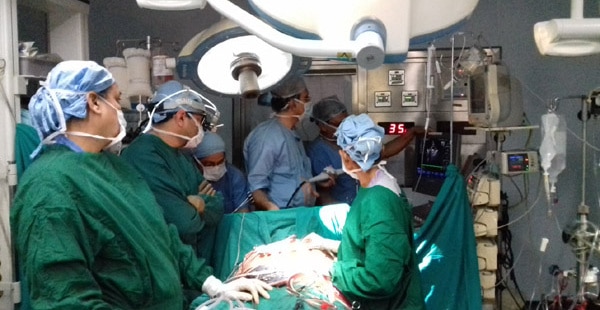 | Beating Heart Bypass Surgery / Completion Angiography MICS CABG / OPCAB / Small Incision Cardiac Surgery Valve Surgery Vascular Surgery Thoracic... View product → |
Frequently asked questions
What does “small incision” mean in a child?
It describes the access route to the heart. The skin opening is often about 3–8 cm, but size depends on the child’s age, body size, anatomy, and repair.
Which heart defects may fit small-incision surgery?
Suitability depends on the defect, its location, the required repair, the child’s size, and the team’s experience. Ask which alternatives are available and why one approach is safer.
How does the team decide whether a child is a candidate?
The team reviews the diagnosis, imaging, anatomy, age, body size, previous operations, medical condition, and the complexity of the planned repair.
What happens during surgery and early recovery?
The surgeon reaches the heart through the planned access route, completes the repair, and monitors the child in intensive care before transfer to a ward. Ask about ventilation, pain control, hospital stay, activity limits, and warning signs.
How should parents weigh the scar against surgical risk?
Treat scar length as one factor. Prioritise a complete repair, safe access, the team’s experience, possible conversion to a larger incision, recovery needs, and long-term outcomes.
Keywords