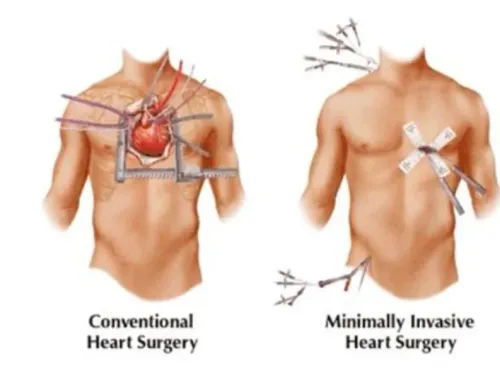

Traditional cardiac surgery has often involved a full sternotomy, in which the breastbone is divided to provide access to the heart. Advances in surgical techniques now allow certain heart operations to be performed through smaller approaches in appropriately selected patients.
Small Incision Cardiac Surgery, commonly discussed within the broader field of minimally invasive cardiac surgery, can offer an alternative surgical approach for selected procedures.
However, a smaller incision does not automatically mean a smaller operation internally.
What Small Incision Cardiac Surgery Means
Minimally invasive cardiac procedures use surgical access that differs from the traditional full midline sternotomy.
Depending on the operation, the surgeon may access the heart through a smaller incision between the ribs or another limited approach.
Specialized instruments, imaging and surgical techniques may be required.
The precise approach varies considerably according to the heart condition being treated.
Which Procedures May Use Smaller Approaches
Minimally invasive techniques may be considered for selected cardiac operations, depending on patient anatomy and the surgical team's expertise.
Possible applications can include certain valve procedures and other selected cardiac operations.
However, not every condition can be safely treated through a limited incision. Complex anatomy, previous operations, associated cardiovascular disease or the need for multiple simultaneous procedures can influence whether a minimally invasive approach is appropriate.
Smaller Does Not Automatically Mean Better
Patients sometimes assume that the smallest incision must represent the most advanced treatment.
That is not necessarily true.
The primary objective of heart surgery is to treat the underlying cardiovascular problem safely and effectively. Incision size is secondary to achieving the required surgical result.
A conventional approach may sometimes provide better exposure or be more appropriate for a particular patient's anatomy.
Potential Advantages in Suitable Patients
Depending on the procedure and individual circumstances, minimally invasive approaches may offer potential benefits related to surgical access and recovery.
However, expected benefits vary according to the operation and patient.
Patients should discuss realistic expectations rather than assuming that a smaller incision guarantees less pain, a shorter hospital stay or faster recovery.
What Determines Eligibility
Before recommending Small Incision Cardiac Surgery, the surgical team evaluates several factors.
These may include:
- Exact heart condition
- Cardiac anatomy
- Previous chest surgery
- Coronary artery disease
- Lung function
- Vascular anatomy
- Other medical conditions
- Need for additional cardiac procedures
Imaging and cardiac investigations help the surgeon determine whether adequate access can be achieved through a minimally invasive approach.
Questions Worth Asking
Patients in Nagpur considering minimally invasive heart surgery can ask:
- Is my condition suitable for a smaller-incision technique?
- What approach would be used?
- Why is it appropriate for my anatomy?
- Would a conventional approach provide any advantage?
- Could the operation need conversion to a larger incision?
- What should I expect during recovery?
Understanding these points is more valuable than selecting a procedure based on incision size alone.
Surgical Planning Should Remain Individualized
Cardiac surgery has evolved considerably, but technological advancement does not eliminate the need for careful patient selection.
The most appropriate technique is the one that addresses the underlying cardiac problem while taking the patient's anatomy, health and surgical requirements into account.
At Dr K G Deshpande Memorial Centre in Nagpur, Maharashtra, patients being evaluated for cardiac surgery can discuss the available surgical approaches with the cardiothoracic team. If a limited-incision technique is clinically suitable, the surgeon can explain why it is being considered and what the procedure involves.
For patients researching Small Incision Cardiac Surgery, the key question should therefore be not simply Can my operation be performed through a smaller incision? but Which surgical approach is most appropriate for my condition?
Keywords