
A smaller chest incision can be suitable for a child with a carefully selected heart defect, but it does not automatically mean a simpler operation or a faster recovery. By the end, you will know which defects and patient factors influence suitability, how this approach differs from catheter treatment and standard sternotomy, and what to ask the surgical team before deciding.
Key takeaways
- Small incision does not mean a simpler heart repair.
- Ask whether the defect can be repaired safely through the proposed route.
- Compare scar location with recovery, visibility, bypass time and safety.
- Choose a team with dedicated paediatric cardiac surgery experience.
What “small incision” means in paediatric heart surgery
A small incision describes the route through the skin and chest, not the complexity of the heart repair. In children, it usually means a right-sided chest incision or partial sternotomy instead of the conventional full midline sternotomy.
It does not automatically mean that a child avoids open-heart surgery. If the repair requires the surgeon to work inside the heart, the operation remains open-heart surgery even when the skin opening is smaller. Cardiopulmonary bypass, using a heart-lung machine, may still be necessary.
The operation can still include:
- General anaesthesia and continuous monitoring
- Cardiopulmonary bypass and its associated blood-thinning treatment
- Chest drainage and a stay in intensive care
A smaller incision therefore does not guarantee freedom from bypass, intensive care or the usual early recovery precautions. It may reduce scar length or alter postoperative pain, but the child still faces the risks of anaesthesia, bypass when required, bleeding, infection and the underlying heart repair.
Minimally invasive heart surgery for children is also different from catheter treatment. A catheter procedure enters through a blood vessel and may avoid an incision in the chest; a small-incision operation does not. Robotic surgery is another technique and is uncommon in young children.
Ask the surgeon to name the exact access route, whether bypass will be used, and how long intensive-care monitoring is expected. Compare the complete operation, not just the scar.
Which children and heart defects may be suitable
There is no universal age or weight cutoff for pediatric small incision cardiac surgery. Anatomy and the planned repair matter more: an older child with a narrow chest or unusual vessels may be harder to operate on than a smaller child with favourable anatomy.
In infants and premature babies, tiny vessels make cannulation, instruments and emergency access more demanding. Chest width, lung disease, pulmonary hypertension, previous operations and safe access to the heart all affect the decision.
| Defect | Small-incision suitability | Why the route changes |
|---|---|---|
| Atrial septal defect | Often suitable when isolated | The opening is accessible through a right-sided approach |
| Ventricular septal defect | Suitable in selected children | Location, size and proximity to valves determine exposure |
| Patent ductus arteriosus | Selected cases | The ductus may be approached through the chest, but anatomy matters |
| Valve disease | Selected repairs | The valve and surrounding structures must be reachable safely |
| Multiple defects or arch reconstruction | Usually unsuitable | The surgeon needs broad access to the heart and great vessels |
A small incision is not the same as catheter treatment or robotic surgery. Device closure and balloon procedures use blood vessels, not a chest incision, and work only when the defect, nearby valves and vessel anatomy meet strict conditions.
Complex neonatal repairs, abnormal vessels or a need for wide reconstruction often make a full sternotomy safer. The team should explain whether it routinely performs the proposed repair at your child’s exact age, weight and chest size, and how it would convert to a sternotomy if exposure or cannulation became unsafe.
How surgeons choose between a small incision and sternotomy
The safest route gives the team enough exposure to control the vessels, use cardiopulmonary bypass and repair every abnormality without dangerous traction. An echocardiogram usually provides the first decision points: the defect’s size and position, valve involvement, chamber function, pulmonary pressure and any additional lesion.
A small, isolated atrial septal defect, selected ventricular septal defect, patent ductus arteriosus or valve problem may suit a right thoracotomy, axillary incision or partial sternotomy. A defect close to a valve, multiple lesions, severe pulmonary hypertension or poor ventricular function can favour a full sternotomy.
| Finding | May support a small incision | May favour full sternotomy |
|---|---|---|
| Echocardiogram | One repairable defect with clear borders and good heart function | Multiple defects, valve damage, uncertain anatomy or severe dysfunction |
| CT scan | Normal great vessels and lung anatomy with a safe working corridor | Abnormal vessels, aortic arch disease, unusual veins, chest deformity or dense prior scarring |
| Medical history | No previous chest operation, major lung disease or bleeding disorder | Previous sternotomy, major adhesions, severe lung disease or a condition needing several procedures |
| Circulation | Stable oxygen levels, manageable pulmonary pressure and planned bypass access | Cyanosis, very high pulmonary pressure, unstable circulation or urgent need for broad exposure |
CT is requested when echocardiography cannot map vessels, lungs or previous surgical changes well enough. Prior operations also matter: scar tissue can make a small route slower and riskier. The decision is therefore individual, not a promise attached to the phrase small incision cardiac surgery for children.
The real trade-offs, risks and reasons to use another approach
A smaller chest incision can mean less visible scarring and, in selected children, less disruption of the breastbone. It does not remove cardiopulmonary bypass, anaesthesia, intensive care, bleeding, infection, rhythm disturbance or residual-defect risks. Narrow access can restrict instrument angles, prolong bypass and make unexpected anatomy harder to manage.
- Match the incision to the repair. Small-incision access fits selected atrial septal defect closures, some ventricular septal defect repairs, patent ductus arteriosus procedures and valve operations. Full sternotomy is often safer for complex neonatal repairs, multiple defects, arch reconstruction, previous operations or anatomy requiring broad access to the heart and great vessels.
- Compare it with catheter treatment. A device closure or balloon procedure avoids a chest incision and may shorten recovery, but it applies only when the defect’s size, edges and distance from valves suit the device. A large defect, inadequate rims, nearby valve tissue or additional lesions can make surgery safer.
- Treat conversion as a safety plan. Limited exposure, bleeding, difficult anatomy or poor progress can require immediate sternotomy; conversion is not necessarily a failure. Ask whether the operating room, paediatric cardiac anaesthetist, perfusionist, intensive care unit, imaging, blood bank and surgical team are ready for it.
- Choose urgent conventional surgery when oxygen levels or circulation are deteriorating, severe obstruction demands rapid relief, or delay increases risk. In that setting, the fastest reliable exposure matters more than scar size.
How to assess a paediatric team before choosing this approach
Ask for the surgeon’s recent number of the exact operation, not the centre’s total number of minimally invasive procedures. Also ask for outcomes in children close to your child’s age, weight and diagnosis, including conversion to full sternotomy, reoperation and serious complications.
Use these questions before choosing small incision cardiac surgery in Nagpur:
- How many children of this weight and age has the team treated through this incision in the past 12 months?
- What cannulation route and instruments will you use, and how will small vessels affect the plan?
- What is your conversion rate to sternotomy, and how quickly can you convert if bleeding, poor exposure or unstable circulation occurs?
- Is paediatric cardiac anaesthesia, perfusion, imaging, blood-bank support and intensive care available on site?
- Do you have extracorporeal membrane oxygenation or another extracorporeal support arrangement, and who performs emergency surgery overnight?
| Question | Reassuring answer | Warning sign |
|---|---|---|
| Exact experience | Published results for this operation in children | Adult minimally invasive experience presented instead |
| Child size | Routine cases near your child’s weight | No clear lower size or weight experience |
| Conversion | Named team, operating plan and equipment ready | “We rarely need to convert” |
| Intensive care | Dedicated paediatric cardiac monitoring and ventilation | General ICU without paediatric cardiac cover |
| Emergency support | Immediate sternotomy, blood and extracorporeal backup | Transfer required during deterioration |
At Dr K G Deshpande Memorial Centre, ask for the same operation-specific figures rather than inferring suitability from its service list. Seek a second opinion when the explanation focuses mainly on scar size or the operation is uncommon in children.
Related product
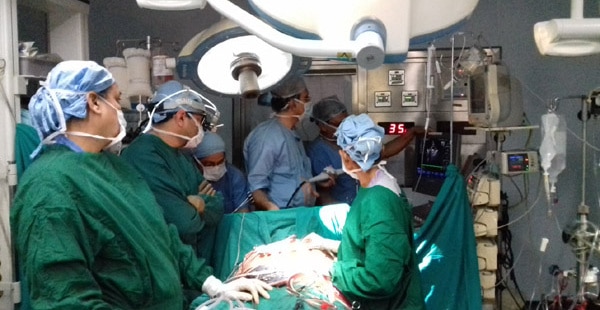 | Beating Heart Bypass Surgery / Completion Angiography MICS CABG / OPCAB / Small Incision Cardiac Surgery Valve Surgery Vascular Surgery Thoracic... View product → |
Frequently asked questions
What does small incision cardiac surgery mean for children?
It describes the route through the skin and chest, such as a right-sided chest incision or partial sternotomy, instead of a full midline sternotomy.
Which children may be suitable for minimally invasive heart surgery?
Suitability depends on the child’s age and size, heart anatomy, repair required, previous operations, medical condition and the surgeon’s experience with that approach.
How do surgeons choose between a small incision and sternotomy?
They compare access to the defect, repair safety, the child’s anatomy, expected bypass and operating time, recovery, and the need for future procedures.
What should parents ask a paediatric cardiac team before choosing this approach?
Ask about the team’s paediatric experience, the exact incision, alternative sternotomy, likely complications, conversion plans, intensive-care needs and follow-up.
Keywords